Digital Identity Is Becoming Mandatory: Here's What Companies Need to Do Now

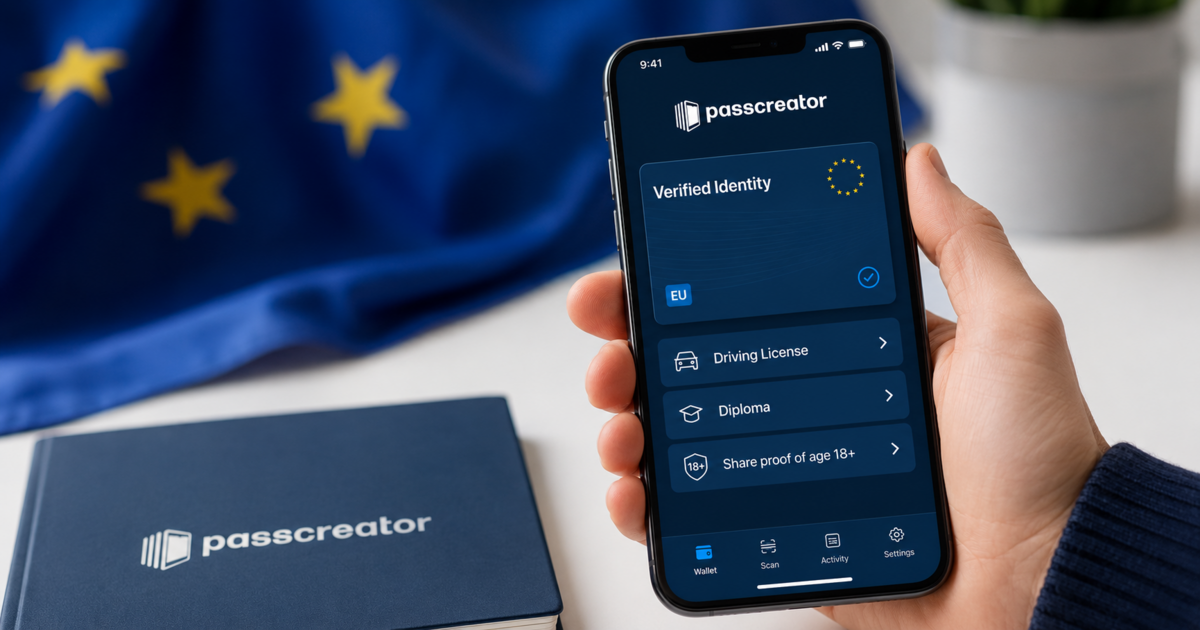
Digital identity is becoming mandatory in the EU. With the eIDAS 2.0 Regulation, the European Union has established a framework that requires companies in regulated industries to accept the so-called EUDI Wallet as proof of identity. Those who fail to prepare in time risk compliance issues and miss an opportunity to streamline their processes.
In this article, you’ll learn who is affected by this requirement, when it takes effect, and what specific steps you need to take.
What does “digital identity is mandatory” actually mean?
When people talk about the digital ID requirement, they’re referring to two different obligations that are often confused:
1. Provision requirement for EU member states
Every EU member state must provide its citizens with at least one EUDI Wallet free of charge. This is the responsibility of governments, not companies. In Germany, the Federal Ministry of the Interior and the Federal Printing Office are working on implementation.
2. Obligation for businesses to accept
Certain industries and companies are required to accept the EUDI Wallet as proof of identity when customers present it. This is the part that is relevant to businesses and is often underestimated.
Important: No one is forced to use the EUDI Wallet. Citizens can continue to show their physical ID card. But if a customer presents their digital identity from their Wallet, certain companies must accept it.
The EUDI Wallet: ID card, driver’s license, and more—all digitally on your smartphone
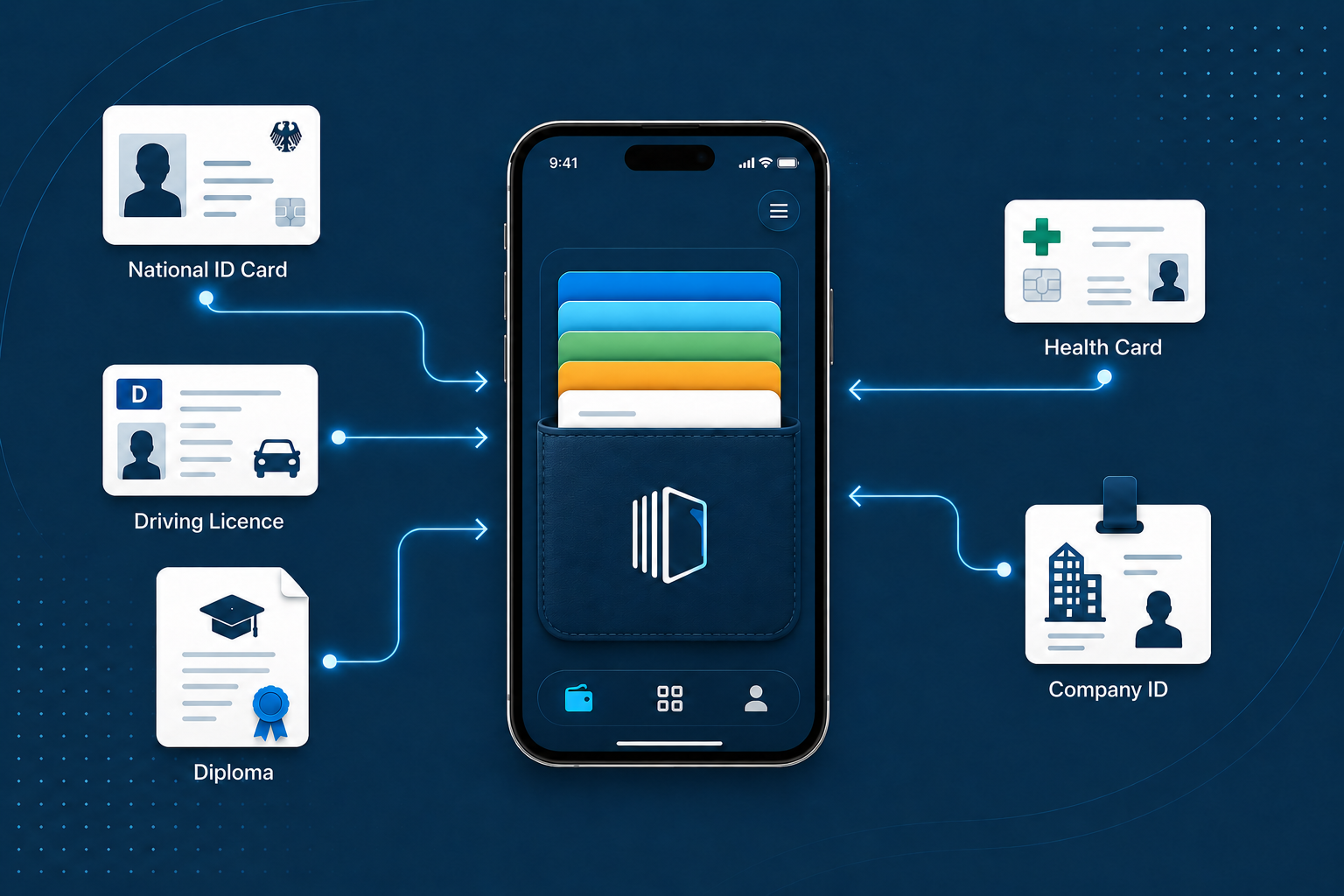
The EUDI Wallet (European Digital Identity Wallet) is an app where citizens can store their official documents digitally:
- ID card in the Wallet—full-fledged digital proof of identity
- Driver’s license in the Wallet—can be presented digitally during checks and for online services
- Degrees and certificates – verifiable and forgery-proof
- Health data – e.g., vaccination records or prescriptions
- Corporate IDs – e.g., access authorizations or membership cards
What makes it special: The wallet works throughout the EU. A German ID card in the Wallet is accepted in France just as it is in Estonia. Users decide for themselves which data they share and with whom. This principle of selective disclosure means that, for example, during age verification, only the fact that the person is over 18 is confirmed, without revealing their name, address, or date of birth.
If you want to know how the EUDI Wallet works technically and what eIDAS 2.0 regulates in detail, read our in-depth article on the basics of eIDAS 2.0 and the EUDI Wallet.
Which industries are required to accept digital identity?
The eIDAS 2.0 Regulation defines specific sectors in which the acceptance requirement applies.
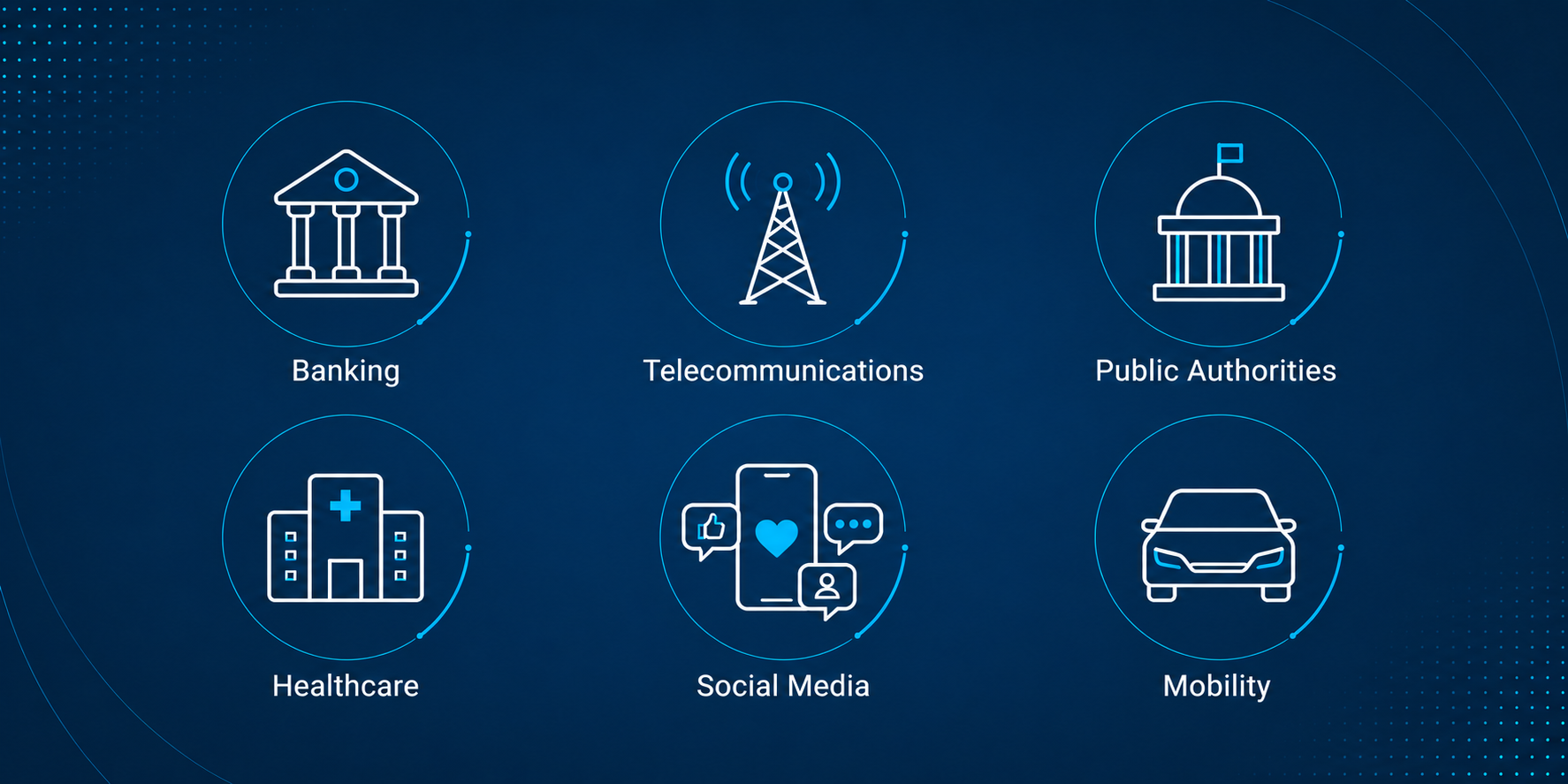
Banks and Financial Service Providers
Banks must accept the EUDI Wallet for customer identification (KYC)—that is, when opening accounts, processing loan applications, and in any situation where identity verification is required by law. This also applies to payment service providers and insurance companies.
Today, opening an account online using video identification takes an average of 8 to 12 minutes and costs the bank between 3 and 6 euros per transaction. With the EUDI Wallet, the process is reduced to just a few seconds: Customers share their identity information in the wallet, and the bank verifies it automatically. No waiting for a Video-Ident agent, no interruptions due to poor camera quality.
Telecommunications
Mobile carriers must accept the EUDI Wallet during SIMregistration. Instead of providing a copy of an ID in-store or going through a cumbersome online verification process, digital proof of identity is transmitted directly from the wallet. For providers with a high volume of new customers, this means a significant reduction in onboarding workload and a lower risk of fraud thanks to cryptographically verified identities instead of manually checked ID copies.
Public Administration
Government agencies at all levels—municipal, state, and federal—must accept the wallet for e-government services. This applies to everything from changing your address to filing tax returns.
Healthcare
Health insurance providers, doctors’ offices, and pharmacies will be able to use the EUDI Wallet for electronic identity verification in healthcare services.
Major Online Platforms
Platforms covered by the Digital Services Act (DSA) must accept the EUDI Wallet for age verification and login. This applies to social networks, marketplaces, and other platforms with a wide reach.
Transportation and Mobility
The EUDI Wallet can contain a digital driver’s license and vehicle registration. Car rental companies, car-sharing services, and mobility platforms will be required to accept these.
Timeline: When will the digital ID become mandatory?
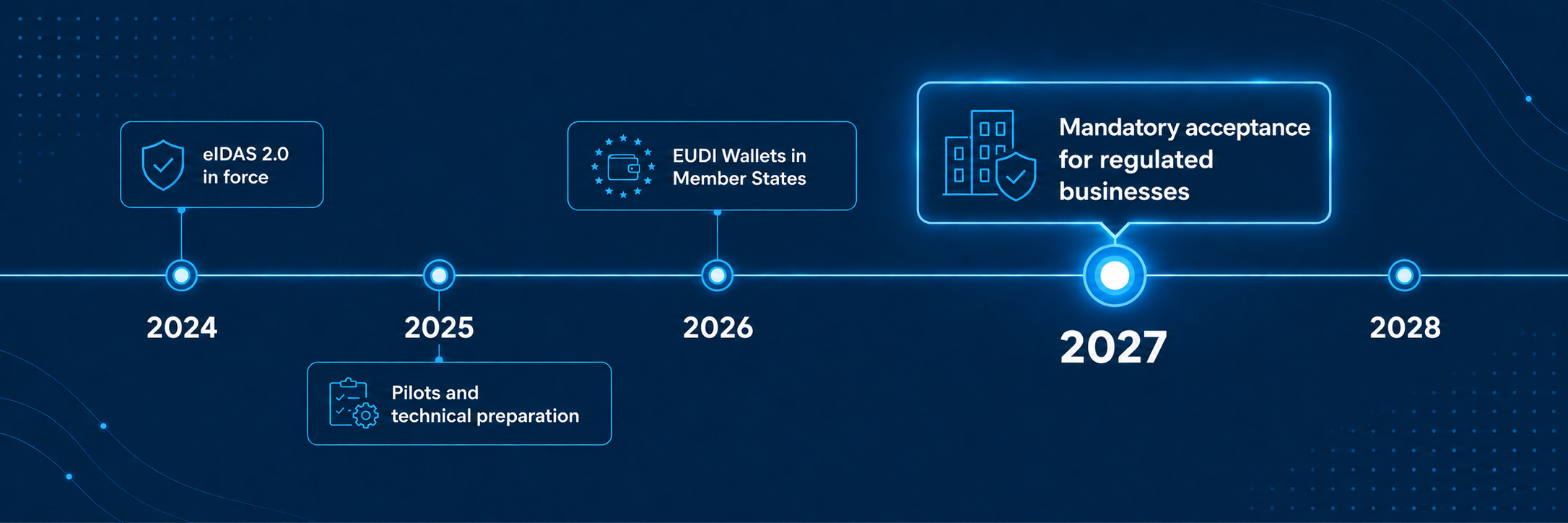
| Milestone | Timeframe |
|---|---|
| eIDAS 2.0 Regulation Adopted | 2024 ✅ |
| Technical standards (Implementing Acts) finalized | 2025/2026 |
| First EUDI wallets available from member states | 2026/2027 |
| Mandatory acceptance for regulated companies | Starting in 2027 |
| Full implementation in all EU member states | 2027–2028 |
Note: The exact deadlines depend on national implementation laws. Germany has announced that it will be among the frontrunners, but delays can never be ruled out with EU regulations. Companies that get started now have a clear advantage.
What happens if companies aren’t prepared?
Regulatory Risks
Companies in regulated industries that do not accept the EUDI Wallet are in violation of the eIDAS 2.0 Regulation. Member states will determine the specific penalties, but they are expected to include substantial fines, similar to those for GDPR violations.
Competitive Disadvantages
Customers increasingly expect digital, frictionless processes. The first to offer seamless EUDI Wallet integration will come out on top:
- Faster onboarding processes, because opening an account takes seconds instead of days
- Lower costs, as Video-Ident, PostIdent, and manual verification are no longer required
- Higher conversion rates, because there are fewer drop-offs during the identification process
- A trust advantage, because modern identity solutions signal a commitment to innovation
Five Steps to Prepare for Mandatory Digital Identity
1. Check if you’re affected
Does your company operate in one of the regulated industries? If you conduct KYC processes, age verification, or government-mandated identity checks, you’re affected.
2. Analyze existing processes
Where in your workflows is identity verification currently performed? Account opening, contract signing, login, access controls: Each of these touchpoints is a potential use case for the EUDI wallet. Create a list of all points where your system currently requires ID, a login, or age verification.
3. Plan technical integration
You’ll need a so-called Relying Party Connector—a technical interface that enables your system to receive and verify credentials from EUDI Wallets. Passcreator’s EUDI Wallet Connector acts as middleware between users’ EUDI Wallets and your existing system. Integration is handled via a REST API; you don’t need to set up your own wallet infrastructure.
4. Launch a pilot project
Don’t wait until it becomes mandatory. The German EUDI Wallet test environment already allows companies to test the integration. A pilot project with a single use case—such as age verification or employee ID cards—is sufficient to understand the technical requirements and adapt internal processes before the mandate takes effect.
5. Inform Existing Customers
Communicate early on that you accept the EUDI Wallet. This builds trust and shows that your company is ready.
How Passcreator Facilitates Implementation
Passcreator offers the EUDI Wallet Connector, a solution that makes it easier for companies to integrate the EUDI Wallet:
- Verification of identity documents from EUDI Wallets
- Combining the EUDI Wallet with Apple and Google Wallet for a seamless experience across all wallet types (read more in our article on combining EUDI with Apple/Google Wallets)
- API-based integration into existing systems
You don’t have to reinvent the wheel. The technical infrastructure already exists.
FAQ: Frequently Asked Questions About the Digital Identity Requirement
Is digital identity mandatory in Germany?
Yes, for certain industries. With the implementation of the eIDAS 2.0 Regulation, regulated companies in Germany must accept the EUDI Wallet as proof of identity. For citizens, use remains voluntary.
When do I have to start accepting the EUDI Wallet?
The acceptance requirement is expected to take effect gradually starting in 2027. The exact deadlines depend on national implementation laws.
Does this requirement also apply to small businesses?
The requirement primarily applies to regulated industries such as banking, telecommunications, healthcare, government agencies, and large platforms. Small businesses outside these sectors are not directly affected but may voluntarily accept the EUDI Wallet to modernize their processes.
What is the difference between the EUDI Wallet and Apple/Google Wallet?
Apple Wallet and Google Wallet are proprietary wallet apps for cards, tickets, and payments. The EUDI Wallet is a government-provided app specifically for verified identity documents. Ideally, both work together. Here’s how.
What does it cost to get ready?
The costs depend on the complexity of your existing systems. With a solution like the Passcreator EUDI Connector, integration can be implemented without extensive in-house development.
The EUDI Wallet is transforming how companies verify identities: faster, more secure, and more cost-effective than today. Those who get started now will have a head start. Learn more about the Passcreator EUDI Wallet Connector →